
Unveiling Molecular Architecture: The Marvel of Orbital Hybridization
The universe around us, from the simplest water molecule to the most complex proteins, is built upon the intricate dance of atoms forming bonds. But how do atoms, with their distinct atomic orbitals, arrange themselves to create the precise geometries that dictate a molecule’s properties and reactivity? The answer lies in a fascinating concept known as orbital hybridization, a cornerstone of Valence Bond Theory that allows us to bridge the gap between theoretical electronic configurations and observed molecular structures.
The Dance of Electrons: Understanding Orbital Hybridization
At its heart, orbital hybridization is the concept of atomic orbital mixing. Imagine an atom preparing for battle, not with swords, but with its electron-holding orbitals. Instead of using its ‘pure’ s and p orbitals directly for bonding, it can combine them to form new, equivalent hybrid orbitals. These hybridized states are energetically more favorable for forming bonds, especially when dealing with multiple equivalent bonds, like those found in methane. This transformation helps explain why molecules adopt specific molecular geometries rather than the simpler arrangements predicted by direct overlap of unhybridized atomic orbitals.
Sp3 Hybridization: The Tetrahedral Marvel of Methane
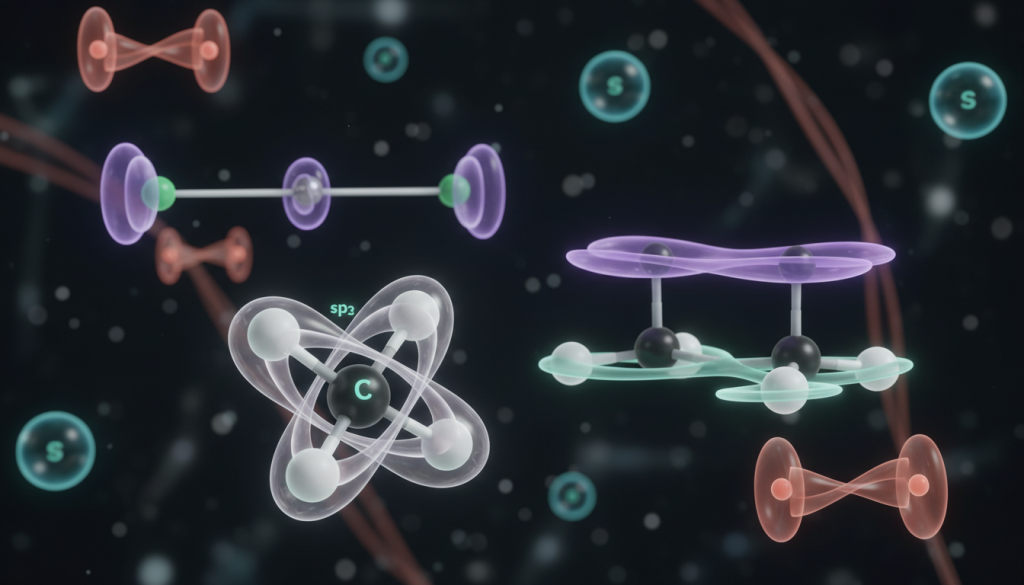
Perhaps the most classic example of hybridization is seen in methane (CH4). Carbon, with an electronic configuration of [He] 2s2 2p2, theoretically only has two unpaired electrons in its p orbitals, suggesting it should form only two bonds. However, we know carbon exhibits a valency of four, forming four identical bonds in methane. This is where sp3 hybridization comes into play. The carbon atom promotes one electron from its 2s orbital to an empty 2p orbital, creating four unpaired electrons. Then, one 2s orbital and three 2p orbitals mix to form four equivalent sp3 hybrid orbitals. These sp3 hybrid orbitals point towards the corners of a tetrahedron, leading to methane’s characteristic tetrahedral geometry with bond angles of approximately 109.5 degrees. Each sp3 orbital then forms a sigma bond with a hydrogen 1s orbital, resulting in a stable and symmetrical molecule.
Sp2 Hybridization: Planar Geometries and Double Bonds
When an atom needs to form a double bond, it often employs sp2 hybridization. Consider ethene (C2H4), a molecule with a carbon-carbon double bond. Each carbon atom in ethene undergoes sp2 hybridization, mixing one 2s orbital with two 2p orbitals to form three equivalent sp2 hybrid orbitals. These three sp2 orbitals lie in a plane, oriented 120 degrees apart, leading to a trigonal planar arrangement around each carbon. The remaining unhybridized 2p orbital on each carbon atom is perpendicular to this plane. Sigma bonding occurs when two sp2 orbitals from adjacent carbons overlap head-on, forming the C-C single bond, and sp2 orbitals on each carbon overlap with hydrogen 1s orbitals. The magic of the double bond comes from the side-by-side overlap of the two unhybridized 2p orbitals, forming a pi bond overlap. Another excellent example of sp2 hybridization leading to a planar structure is boron trifluoride (BF3), where the boron atom is sp2 hybridized, resulting in a trigonal planar molecular geometry.
Sp Hybridization: Linear Structures
For molecules requiring a linear arrangement, sp hybridization is the key. Take beryllium chloride (BeCl2) as an example. Beryllium, a Group 2 element, typically forms two bonds. In BeCl2, the beryllium atom undergoes sp hybridization, where one 2s orbital mixes with one 2p orbital to form two equivalent sp hybrid orbitals. These two sp orbitals are oriented 180 degrees apart, resulting in a linear geometry. Each sp hybrid orbital then forms a sigma bond with a chlorine 3p orbital. This arrangement minimizes electron-electron repulsion and leads to a stable linear molecule. Similarly, in acetylene (C2H2), each carbon atom is sp hybridized, forming a sigma bond between carbons and two pi bonds from the overlap of the remaining unhybridized 2p orbitals, resulting in a linear molecule.
Beyond the Basics: Expanding Hybridization Concepts
While sp, sp2, and sp3 hybridization cover many common organic and inorganic molecules, hybridization extends further to explain more complex molecular geometries, often involving d orbitals. For instance, square planar complexes, like many transition metal compounds, can be explained by dsp2 hybridization, where one d, one s, and two p orbitals combine. For octahedral geometries, seen in molecules like SF6 or many coordination compounds, d2sp3 octahedral hybridization is invoked, involving two d, one s, and three p orbitals. These higher-order hybridizations demonstrate the versatility of atomic orbital mixing in accommodating various bonding situations.
It’s crucial to remember that orbital hybridization doesn’t exist in isolation; it integrates seamlessly with other theories like VSEPR theory. While VSEPR theory (Valence Shell Electron Pair Repulsion theory) predicts the electron-pair geometry based on minimizing repulsion between electron groups (including lone pair interaction), hybridization provides the underlying explanation for how those orbitals form to achieve that geometry. For example, the presence of lone pairs affects both VSEPR geometry and the effective hybridization, influencing bond angles and overall molecular shape. Understanding the hybridization energy involved in forming these hybrid orbitals helps chemists predict the stability and reactivity of different molecular structures.
Ultimately, the concept of orbital hybridization serves as a powerful conceptual tool, allowing chemists to visualize and predict the three-dimensional structures of molecules with remarkable accuracy. It moves us beyond simple Lewis structures and into a deeper understanding of the quantum mechanical nature of bonding, revealing the elegant ways atoms adapt their electronic configurations to achieve stability and form the diverse array of compounds that make up our world. By understanding how atomic orbitals mix and merge, we gain profound insights into why molecules behave the way they do, laying the groundwork for designing new materials and understanding biological processes.