
The Invisible Lattice: How Modular EV Platforms and Sustainable Supply Chains Are Crafting the Next Era of Automotive Resilience
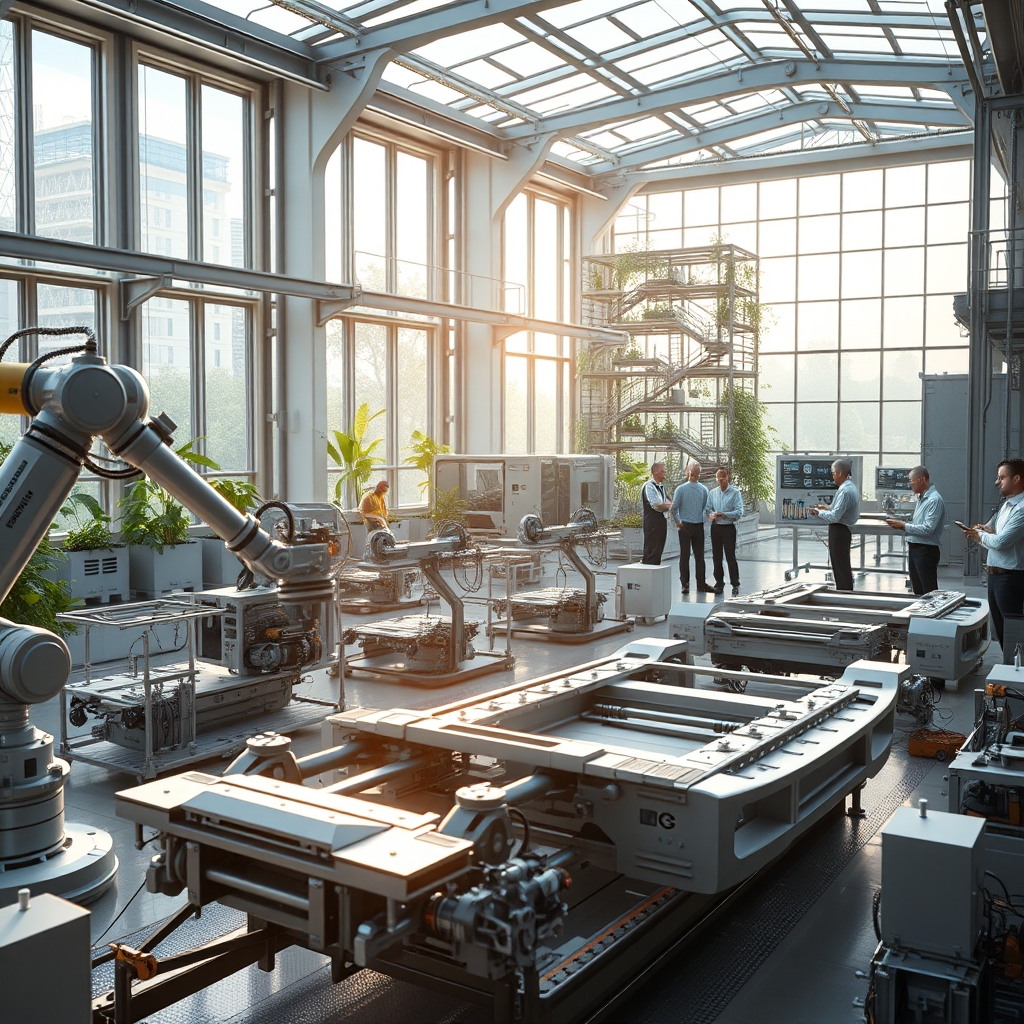
The automotive industry is undergoing a seismic shift, not just in how vehicles are powered, but in how they are conceived, constructed, and connected to the broader ecosystem. At the heart of this transformation lies a dual revolution: the rise of modular electric vehicle (EV) platforms and the relentless pursuit of sustainable supply chains. Together, these innovations are weaving an invisible lattice—a structural and philosophical framework—that promises to redefine resilience, efficiency, and adaptability in mobility.
The Modular Mindset: Building Flexibility into the Foundation
Modular EV platforms represent a paradigm shift from the traditional, rigid architectures of internal combustion engine vehicles. Unlike their predecessors, which were often designed around a single model or drivetrain, modular platforms are engineered to be inherently flexible. They serve as a blank canvas, capable of accommodating a wide range of vehicle types—from compact city cars to sprawling SUVs—without requiring a complete redesign of the underlying structure.
This flexibility is achieved through a combination of standardized components, scalable battery packs, and adaptable chassis designs. For instance, a single modular platform can support different wheelbases, battery configurations, and even powertrain layouts, allowing automakers to respond swiftly to market demands or regulatory changes. The Volkswagen Group’s MEB platform and Tesla’s unibody architecture are prime examples of this approach, enabling rapid iteration and cost-effective production across multiple models.
But the benefits of modularity extend beyond manufacturing efficiency. By decoupling the vehicle’s hardware from its software, modular platforms also pave the way for over-the-air (OTA) updates, predictive maintenance, and even autonomous driving capabilities. This separation allows automakers to future-proof their vehicles, ensuring they can evolve alongside technological advancements without requiring physical modifications.
The Sustainable Supply Chain: The Backbone of Resilient Mobility
While modular platforms provide the structural flexibility, sustainable supply chains ensure the ethical and environmental integrity of the entire production process. The automotive industry has long been criticized for its reliance on conflict minerals, carbon-intensive manufacturing, and linear economies that prioritize disposability over longevity. However, the shift toward electrification has forced a reckoning with these challenges, prompting automakers to rethink their supply chains from the ground up.
At the forefront of this movement is the circular material economy, which emphasizes the reuse, recycling, and repurposing of materials to minimize waste and reduce environmental impact. Companies like BMW and Volvo are leading the charge by integrating recycled aluminum, steel, and plastics into their vehicles, while also exploring bio-based alternatives like bio-synthetic leather and plant-derived polymers. These efforts not only reduce the carbon footprint of production but also insulate automakers from the volatility of raw material markets.
Sustainable supply chains also extend to the sourcing of critical components like batteries and semiconductors. The demand for lithium, cobalt, and nickel—key ingredients in EV batteries—has surged in recent years, raising concerns about ethical mining practices and geopolitical dependencies. To address these issues, automakers are investing in vertical integration, partnering with mining companies to ensure responsible sourcing, and exploring alternative battery chemistries, such as solid-state or sodium-ion, that reduce reliance on scarce materials.
The Synergy of Modularity and Sustainability
The true power of modular EV platforms and sustainable supply chains lies in their synergy. Modularity enables automakers to optimize material usage, reducing waste and improving recyclability. For example, a single modular platform can be designed to accommodate recycled or bio-based materials without compromising structural integrity, while standardized components make it easier to disassemble and repurpose vehicles at the end of their lifecycle.
Moreover, modular platforms facilitate the adoption of advanced manufacturing techniques, such as 3D printing and additive manufacturing, which further enhance sustainability. These technologies allow for on-demand production of components, reducing inventory waste and enabling localized manufacturing, which cuts down on transportation emissions. Companies like Local Motors have already demonstrated the potential of this approach, using 3D printing to produce entire vehicle bodies with minimal material waste.
The Road Ahead: A Resilient and Adaptive Future
The convergence of modular EV platforms and sustainable supply chains is not just a technological evolution—it is a philosophical one. It represents a departure from the linear, extractive models of the past and a move toward a more circular, adaptive, and resilient future. As automakers continue to refine these approaches, the benefits will extend beyond the vehicles themselves, influencing urban planning, energy infrastructure, and even consumer behavior.
Imagine a world where vehicles are no longer static products but dynamic nodes in a broader ecosystem. Modular platforms could enable car-sharing services to swap out battery packs or interior configurations on demand, while sustainable supply chains ensure that every component is ethically sourced and fully recyclable. This vision is not a distant fantasy but an imminent reality, driven by the invisible lattice of innovation that is reshaping the automotive industry from the ground up. The road ahead is not just about getting from point A to point B—it’s about redefining what mobility means in a world that demands both progress and responsibility.