Driving Tomorrow: Unpacking the Future of Automotive Innovation

The automotive industry is in the midst of a profound transformation, driven by innovations that are redefining how we travel and interact with our vehicles. From the rapid expansion of Electric Vehicle Infrastructure to the sophisticated algorithms powering autonomous driving, the future of mobility is undeniably exciting and complex. This era promises not just faster or more efficient cars, but an entirely new ecosystem of transportation, connectivity, and sustainability. Buckle up as we explore the groundbreaking technologies poised to reshape our roads and skies.
Powering the Future: Advanced Propulsion & Energy Solutions
The shift away from fossil fuels is accelerating, pushing the boundaries of vehicle propulsion and energy storage. This fundamental change is paving the way for cleaner, more sustainable transportation options that are also increasingly powerful and convenient.
The Rise of Electric Vehicle Infrastructure and Solid State Batteries
A robust Electric Vehicle Infrastructure is crucial for widespread EV adoption. Governments and private companies are investing heavily in charging networks, ensuring that range anxiety becomes a thing of the past. These advancements are complemented by breakthroughs in battery technology, with Solid State Batteries promising higher energy density, faster charging times, and enhanced safety compared to current lithium-ion counterparts.
Such innovations are not just about powering vehicles; they’re about creating a seamless energy ecosystem. The efficiency and longevity of these new power sources are key to the sustainable future of personal and commercial transport.
Hydrogen Fuel Cells and Bidirectional Charging
Beyond pure electric, Hydrogen Fuel Cells offer another compelling zero-emission solution, particularly for heavy-duty vehicles and regions where electric charging infrastructure might be challenging. These systems convert hydrogen into electricity, emitting only water vapor.
Adding another layer of innovation, Bidirectional Charging allows electric vehicles to not only draw power from the grid but also feed electricity back into it. This capability can stabilize the grid, power homes during outages, and turn EVs into mobile energy storage units, enhancing their value proposition significantly.
Intelligent Mobility: Autonomy and Connectivity Redefined
Vehicles are evolving into intelligent, connected platforms, moving beyond simple transportation to become integral parts of our digital lives. This intelligence is transforming both the driving experience and the broader urban landscape.
Autonomous Driving Systems and Advanced Driver Assistance
The development of Autonomous Driving Systems is progressing rapidly, promising safer roads and reduced traffic congestion. These systems leverage an array of sensors, AI, and real-time data processing to navigate complex environments.
Complementing full autonomy, Advanced Driver Assistance Systems (ADAS) like adaptive cruise control, lane-keeping assist, and automatic emergency braking are already enhancing safety and comfort in modern vehicles. These features are the building blocks toward a fully autonomous future.
Software Defined Vehicles and Connected Car Ecosystems
Modern cars are increasingly Software Defined Vehicles, meaning their capabilities and features are determined more by code than by hardware alone. This allows for over-the-air updates, personalization, and the rapid introduction of new functionalities.
This software-centric approach fuels the growth of Connected Car Ecosystems. Vehicles communicate with each other (V2V), with infrastructure (V2I), and with the cloud, enabling real-time traffic updates, predictive maintenance, and integrated infotainment services that enhance every journey.
The Driver Experience: Inside and Out
As vehicles become smarter, the focus on the human-machine interface and the in-cabin experience intensifies. Future interiors will be more intuitive, personalized, and environmentally conscious.
Augmented Reality Dashboards and Biometric Vehicle Access
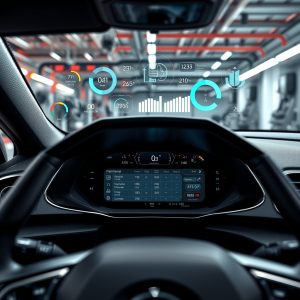
Imagine navigation projected directly onto the road ahead, or crucial information appearing contextually in your line of sight. Augmented Reality Dashboards are set to revolutionize how drivers receive information, making it more intuitive and less distracting. This immersive technology blends digital information with the real world.
For enhanced security and personalization, Biometric Vehicle Access systems are emerging. Fingerprint scanners, facial recognition, or even iris scans could replace traditional keys, automatically adjusting seat positions, mirror settings, and infotainment preferences for individual drivers.
Sustainable Interiors and Smart Glass Technology
The drive for sustainability extends to the cabin itself. Sustainable Interiors utilize recycled plastics, plant-based materials, and vegan leathers, reducing the environmental footprint of vehicle manufacturing. These materials are not only eco-friendly but also offer new aesthetic possibilities.
Adding a touch of futuristic luxury, Smart Glass Technology allows occupants to instantly change the opacity of windows, providing privacy, reducing glare, or enhancing the view with a touch. This dynamic control over light and privacy transforms the cabin atmosphere.
Beyond the Road: New Horizons in Mobility
The future of mobility isn’t confined to ground transportation. Innovative solutions are emerging to tackle urban congestion and provide flexible, on-demand travel options.
Urban Air Mobility and Micro Mobility Solutions
Urban Air Mobility (UAM), featuring electric Vertical Take-Off and Landing (eVTOL) aircraft, promises to alleviate traffic congestion by taking to the skies. These air taxis could offer a new dimension of rapid, inter-city travel.
At the other end of the spectrum, Micro Mobility Solutions like electric scooters, bikes, and compact personal vehicles are transforming last-mile travel in urban areas. These nimble options offer convenient, eco-friendly ways to navigate crowded cityscapes.
Retrofit Electrification and Subscription Based Features
Even classic cars can join the electric revolution through Retrofit Electrification, converting gasoline vehicles into EVs. This offers a sustainable way to preserve automotive heritage while embracing modern technology.
Furthermore, the automotive business model is shifting with Subscription Based Features. Owners might subscribe to performance upgrades, advanced driver assistance features, or even heated seats on demand, offering unprecedented flexibility and customization.
Engineering for a Greener Tomorrow
The commitment to sustainability is woven into every stage of a vehicle’s lifecycle, from design and manufacturing to its eventual use and recycling. This holistic approach ensures a truly green future for the industry.
Carbon Neutral Manufacturing and Digital Twin Engineering
Achieving Carbon Neutral Manufacturing is a key goal for many automakers, focusing on renewable energy sources, waste reduction, and efficient production processes. This commitment extends to the entire supply chain.
Digital Twin Engineering involves creating virtual replicas of vehicles and their components, allowing for rigorous testing, optimization, and predictive maintenance before physical prototypes are even built. This significantly reduces development time, costs, and material waste, while also optimizing performance, including features like Regenerative Braking systems that capture kinetic energy to recharge batteries.
The automotive landscape is undergoing a monumental shift, driven by a confluence of technological advancements and a global push for sustainability. From the rapid evolution of Electric Vehicle Infrastructure to the sophisticated capabilities of Autonomous Driving Systems and the innovative use of Sustainable Interiors, every aspect of vehicle design, performance, and ownership is being reimagined. Staying informed about these developments will not only prepare you for the roads of tomorrow but also empower you to make smarter, more sustainable choices in your personal mobility journey.